
Nominal gold prices measure gold in currency units, while real prices adjust those units for inflation. Understanding the distinction makes long-term charts more useful and prevents a rising headline price from being mistaken for a matching gain in purchasing power.
A nominal gold price tells you the number of currency units paid for gold. An inflation-adjusted price asks how much those units can buy relative to a selected base period. The two answer different questions, so neither should silently replace the other.
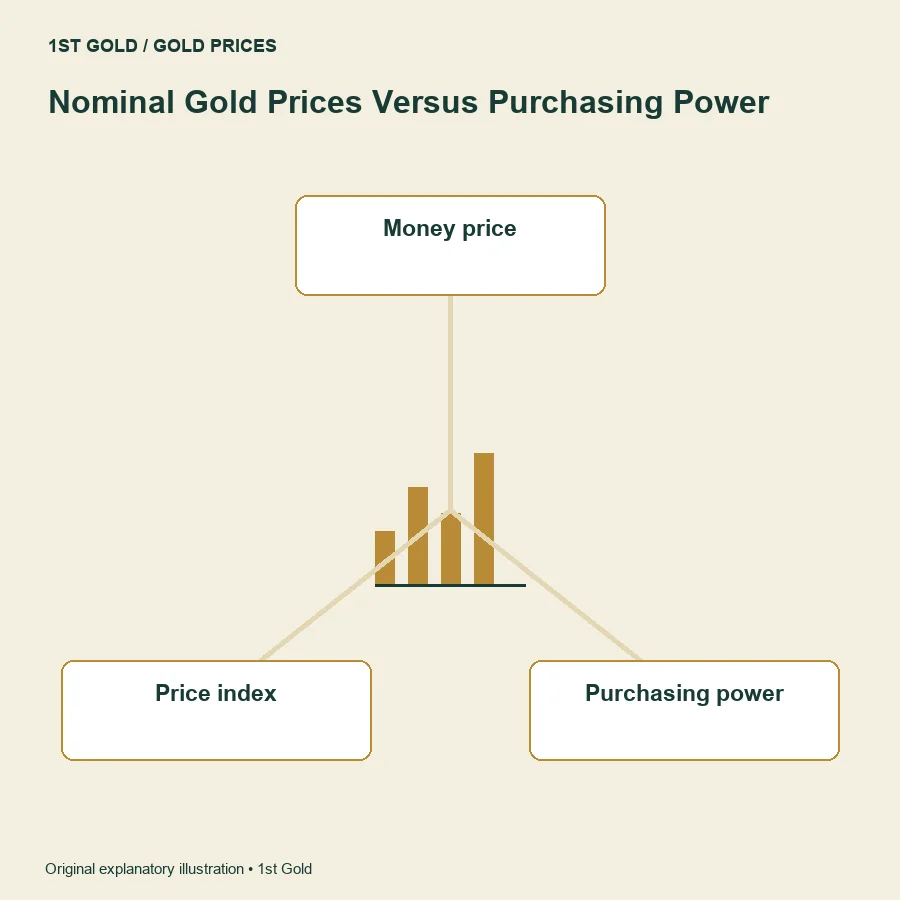
A simple index example
Assume gold increases from 100 to 120 while a consumer-price index rises from 100 to 125. Dividing 120 by 1.25 gives 96 in base-period purchasing-power terms. The nominal gain is 20%, but the inflation-adjusted change is minus 4%. This constructed example is not a historical gold return.
Choose the comparison carefully
The result depends on the inflation measure, country, start date and end date. A household's actual expenses may differ from a broad price index. Storage, dealing costs and taxes are separate from the quoted metal price and can further change a holder's outcome. When reading a claim that gold preserved purchasing power, look for the full period and method. A selected start date near a market peak or trough can dominate the story.
A worksheet for nominal gold prices
Choose a base date and write its price index beside the gold price. Repeat this for the ending date. The inflation adjustment uses the ratio between those index readings, rather than simply subtracting an inflation percentage from the final gold price. Keep the country and currency consistent across the calculation and label any conversion separately.
To make a comparison reproducible, record the series name and whether the observations are monthly averages or particular dates. Avoid combining a daily peak in gold with an annual average for inflation without explaining the mismatch. Finally, distinguish the purchasing power of the quoted metal from a holder's net result. The latter also depends on the actual buying and selling prices and any costs paid along the way.