
The gold interest rates relationship involves expectations as well as the rate announced today. A useful explanation compares the news with what the market anticipated and considers currency movements, inflation expectations and the timing of the gold quotation.
Gold does not pay a contractual coupon. That makes the return available on other assets relevant to its relative appeal, but an interest-rate announcement is not a one-variable forecasting rule. Markets also react to what was expected before the announcement.
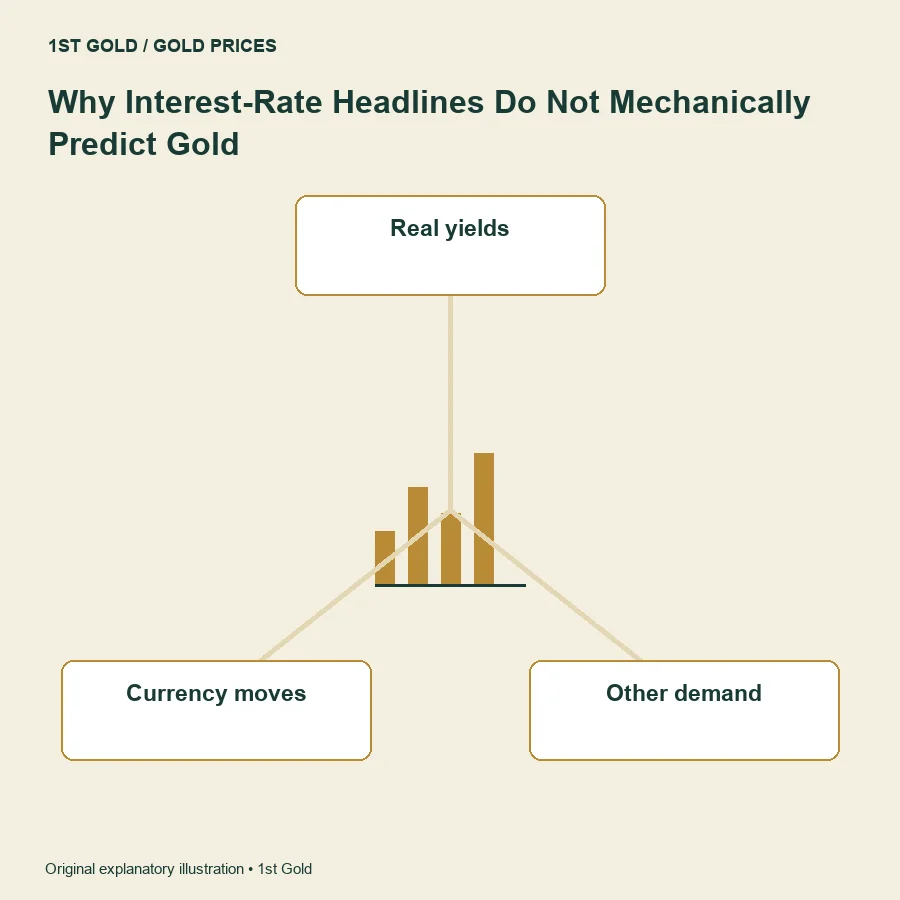
Separate level from surprise
A rate increase that traders already anticipated may produce a smaller response than an unexpected change in the outlook. Inflation expectations matter too: a nominal rate and a real, inflation-adjusted yield are different measures. Currency movements, positioning and demand for liquidity can pull in different directions.
Read the whole event
Write down the time of the announcement, the gold quote's currency and the comparison window. A daily chart can combine the announcement with unrelated news released later. Avoid treating a short price reaction as proof of a permanent relationship. A useful explanation states competing influences and acknowledges uncertainty. It does not convert one day's correlation into a promise about the next policy meeting or a reason to make a hurried purchase.
Reading gold interest rates news carefully
Consider two hypothetical announcements with the same increase in the policy rate. In one case, the increase matches prior expectations. In the other, it is smaller than expected. The announced change is identical, but the new information differs. That is why a headline about the direction of rates cannot, on its own, explain the direction of the gold price.
For a short event study, keep notes on the announcement time, the price immediately beforehand and the later observation. Then list other developments during that window. If several things changed together, describe the result as a reaction around the event rather than proof of one cause. This approach leaves room for uncertainty while making your explanation more precise and easier for another reader to check.