
Central bank gold reserves are part of an institution's wider reserve and policy framework. Understanding their role requires looking at the bank's stated objectives and reported holdings, rather than assuming every institution holds gold for exactly the same reason.
Gold is one component of some central banks' reserve portfolios. It has different characteristics from foreign-currency deposits and securities, so understanding its role requires looking at the reserve manager's objectives rather than assuming all reserves serve the same purpose.
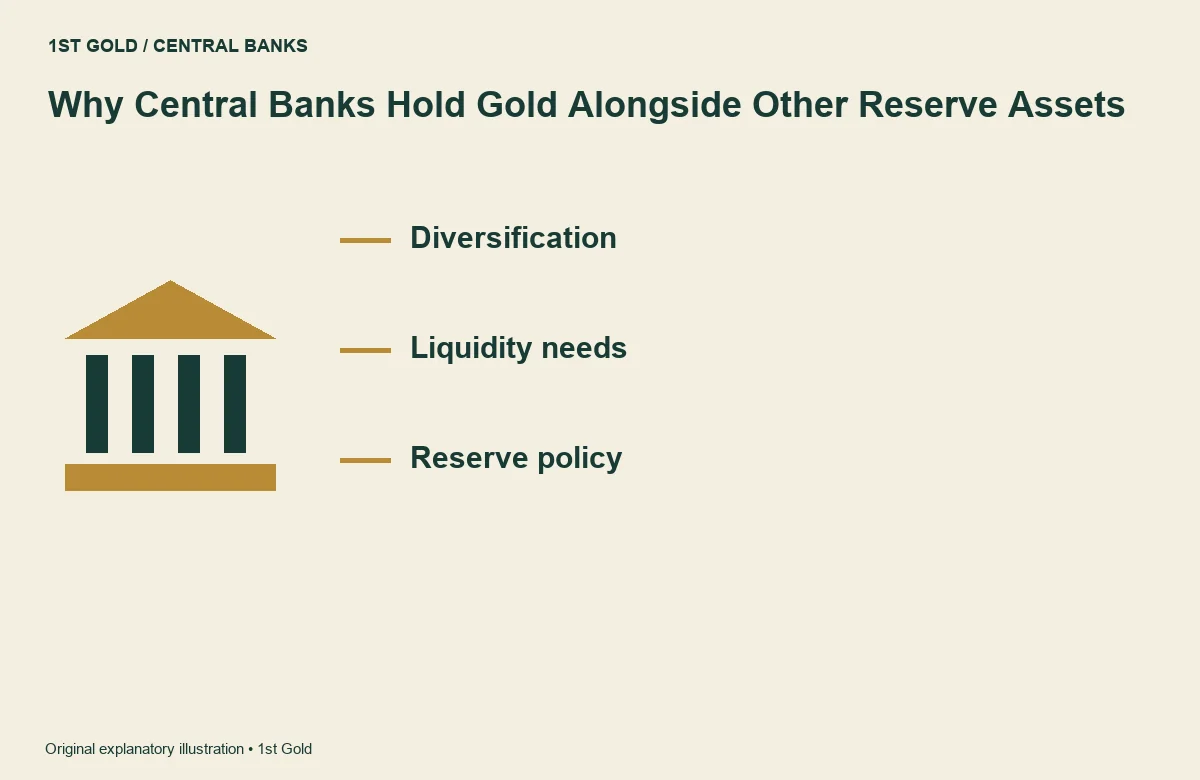
A portfolio with several tasks
Reserve management can involve liquidity, security and financial return, along with institutional and policy constraints. Gold does not pay a contractual coupon and has storage and price risks. Its role therefore cannot be inferred from its physical durability alone.
Read the institution's explanation
Consult the central bank's own reporting for its policy, accounting and custody arrangements. The World Gold Council's official-sector data provide a useful starting point for reported holdings, but a quantity does not explain the reason behind every decision. Avoid treating one country's purchase as a universal recommendation for private investors. A reserve institution has obligations, a time horizon and access to markets that differ from those of a household. The most informative comparison connects the asset to the institution's stated purpose.
Reading central bank gold reserves in context
Start with the institution's own explanation of its reserve policy. Identify which objectives it discusses and how gold fits alongside other assets. Avoid treating a general description of gold's properties as proof of the motive behind a particular transaction. A specific claim about a bank's decision needs evidence from that bank or another clearly identified source.
When reviewing the balance sheet, separate quantity from valuation and location. A higher reported currency value may reflect a price change even when the amount of gold is unchanged. A custody transfer may change location without changing ownership. Keep those three dimensions in distinct columns when comparing periods. This simple structure helps prevent a headline about reserves from combining several different developments into one unsupported story about buying or selling.
Source and further reading
World Gold Council: Official gold reserves and methodology. Reference checked on 14 November 2026. The linked source supports the relevant definitions or background; illustrative calculations above are our own.