
Gold provenance concerns the documented history associated with an object, while reused metal can have earlier lives that remain unknown. Separating those questions prevents an old-looking surface or an appealing story from replacing verifiable evidence.
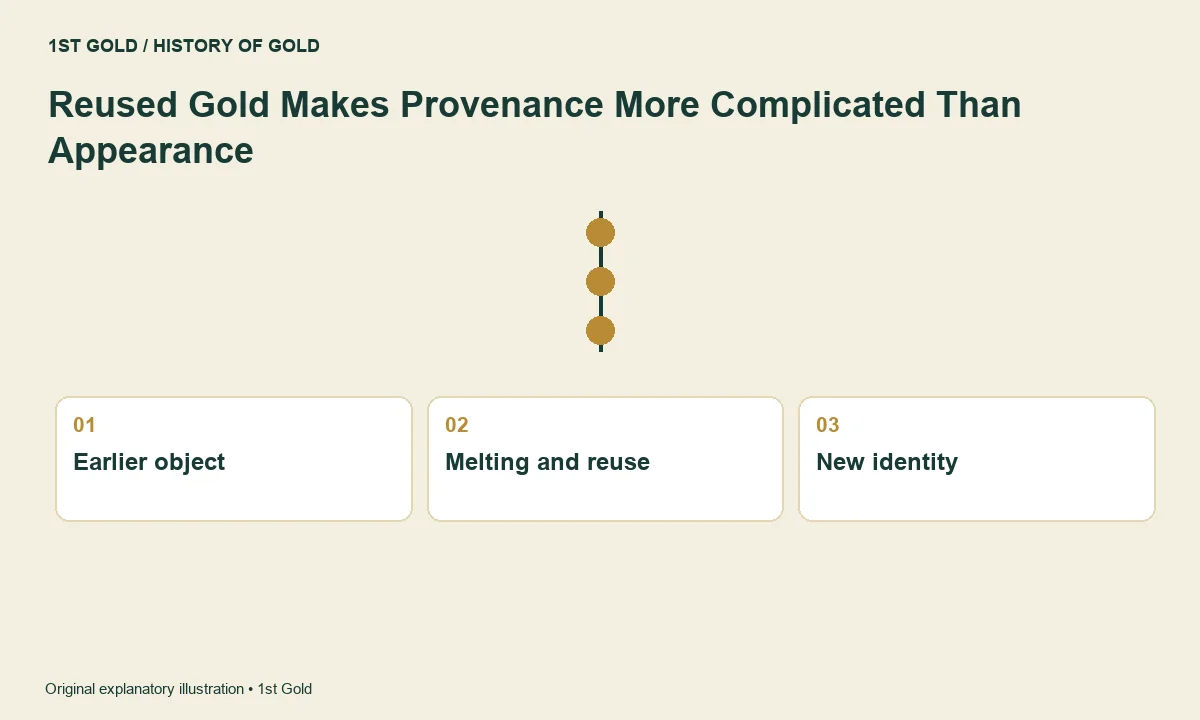
Gold can be melted and made into a new object. The resulting piece may contain old metal while having a much more recent design and manufacturing date. The age of the metal and the age of the object are therefore different questions.
Follow the documented history
Provenance concerns the record of ownership and origin associated with an object. A plausible story or an antique-looking surface is not the same as documentation. Retain invoices, collection labels and references to published catalogues where available.
Avoid impossible precision
Without suitable evidence, it may be impossible to identify every earlier use of the metal. That uncertainty should be stated rather than filled with an appealing narrative. For collectible or archaeological objects, authenticity, lawful provenance and conservation can matter more than a simple metal-content estimate. Reuse is an important part of gold's history, but it also limits what can be inferred from the object alone. A careful description distinguishes verified facts, expert interpretation and unconfirmed tradition.
Building a gold provenance record
Arrange available documents in date order and connect each one to the exact object it describes. Note identifying marks, photographs and catalogue references that support the connection. A receipt for an unspecified gold item is less informative than a record clearly tied to the piece in question. Mark gaps openly rather than creating a smooth narrative across periods for which no evidence survives.
Keep different kinds of conclusions separate. An expert attribution of manufacture, a record of ownership and a compositional analysis may each answer a different question. None should silently stand in for the others. If the metal has been reused, describe only what the evidence supports about that reuse. A useful provenance account is a traceable record with explicit uncertainties, not a claim to know every earlier object from which the metal might have come.