
Gold net asset value and a product's market price are related but distinct measures. Comparing them requires matching their units, currencies and valuation times, rather than treating every displayed difference as an immediately available trading opportunity.
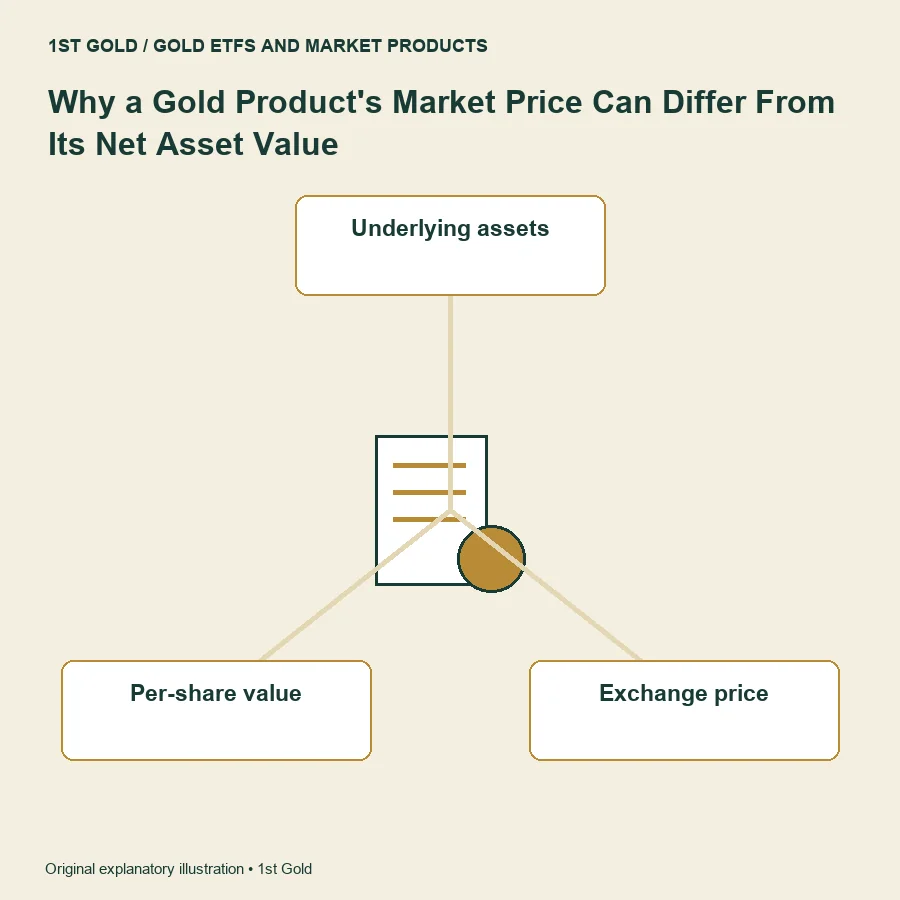
Net asset value is a calculation based on a product's assets and liabilities. The exchange price is the price at which its shares or units trade. They can differ, especially when valuation times, market hours or trading conditions do not align.
Compare the same moment
A published end-of-day NAV should not be compared uncritically with a live quote from a different time. Currency conversions and stale underlying prices can also distort the apparent premium or discount. Check the methodology and timestamp.
Read the mechanism
Some structures use creation and redemption processes that can help connect market price to underlying value. Those processes have participants, costs and constraints; they do not promise that every trade occurs exactly at NAV. Review the product's documents and exchange information. A displayed discount may be meaningful, temporary or partly an artefact of mismatched observations. Understanding the calculation is more useful than treating a single percentage on a website as an obvious buying opportunity.
Comparing gold net asset value with a quote
Write down whether the published figure is total net assets, net asset value per unit or an indicative intraday estimate. Then record the time to which it applies. A closing value from the previous day and a live market quote can differ partly because they refer to different moments. That timing difference should be resolved before interpreting a premium or discount.
Use the issuer's stated method for a reproducible comparison. If you calculate a percentage difference, identify the denominator and preserve the unrounded inputs. Separately note the bid, ask and transaction costs relevant to an actual purchase or sale. A displayed midpoint is not necessarily the price available to you. These checks turn a striking difference on a screen into a clearly defined observation with practical limits.
Source and further reading
U.S. SEC Investor.gov: Characteristics of Mutual Funds and ETFs. Reference checked on 14 November 2026. The linked source supports the relevant definitions or background; illustrative calculations above are our own.