
Museum gold displays offer concise introductions to objects whose histories can be complex. Reading the qualifications in a label, then consulting the catalogue, helps distinguish established information from an attribution, approximate date or open research question.
A museum label compresses research into a small space. Terms such as “attributed to”, “probably” and “circa” communicate uncertainty and should not disappear when the object is discussed elsewhere.
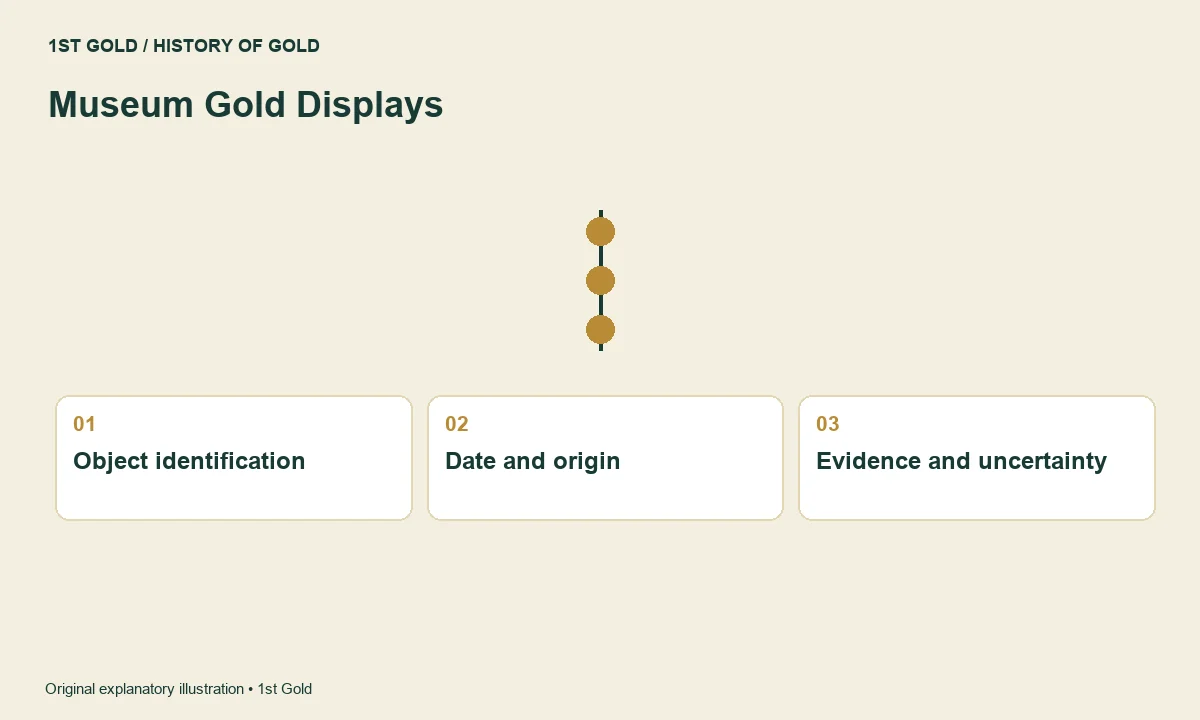
Separate the fields
Identify the stated date, place, material and function. Ask whether the date refers to manufacture, burial or a later alteration. A description of “gold” may be refined in a detailed catalogue with information about alloys, gilding or analytical methods.
Follow the record
Where available, consult the museum's full catalogue entry and provenance information. A display photograph cannot replace those details. Avoid turning an approximate date into an exact year or an attribution into a confirmed identity. The label is a starting point for learning, not a list of facts to embellish. Reading its qualifications carefully produces a more accurate account and respects the distinction between what researchers have established and what remains open to interpretation.
Taking notes on museum gold displays
Record the object's accession or catalogue identifier if one is supplied. Keep the museum's wording for uncertain dates and attributions, rather than silently making them more precise. Separate the label's statements about material, manufacture and find location; those may rest on different forms of evidence. A place associated with discovery is not automatically the place where an object was made.
When sharing a photograph or writing a summary, preserve that distinction. Include the catalogue reference and describe what the image itself shows without adding an unsupported origin story. If a later catalogue entry updates an older display label, note the version and date consulted. The goal is an accurate account that invites further reading, not a more dramatic account created by removing the museum's careful qualifications.