
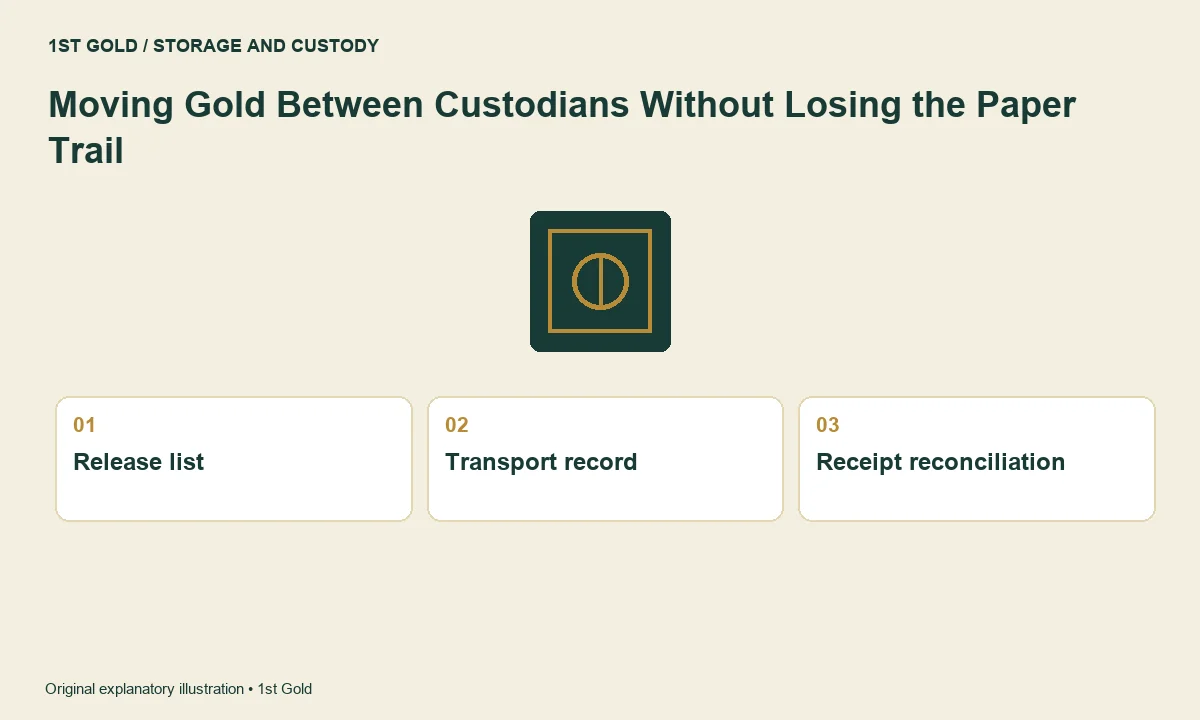
A transfer involves several records that should tell the same story: the releasing custodian's list, the transport documentation and the receiving custodian's acknowledgement. Differences should be resolved before the old arrangement is treated as closed.
Agree acceptance first
Confirm that the destination accepts the exact products and what testing, handling or re-assaying may be required. Establish who arranges transport, who bears risk at each stage and how any insurance applies. A release instruction alone does not establish that the transfer is complete.
Reconcile the arrival
Compare identifiers, quantities, units and fine weights. Record any substitution or packaging change and retain both the outgoing and incoming statements. Check that billing stops and starts as agreed. If the destination uses a different account structure, understand how your ownership or entitlement changes. A good transfer process preserves evidence across the handover rather than leaving a gap between two account dashboards that happen to display similar totals.
Source and further reading
Bank of England: Gold custody and ownership. Reference checked on 14 November 2026. The linked source supports the relevant definitions or background; illustrative calculations above are our own.