
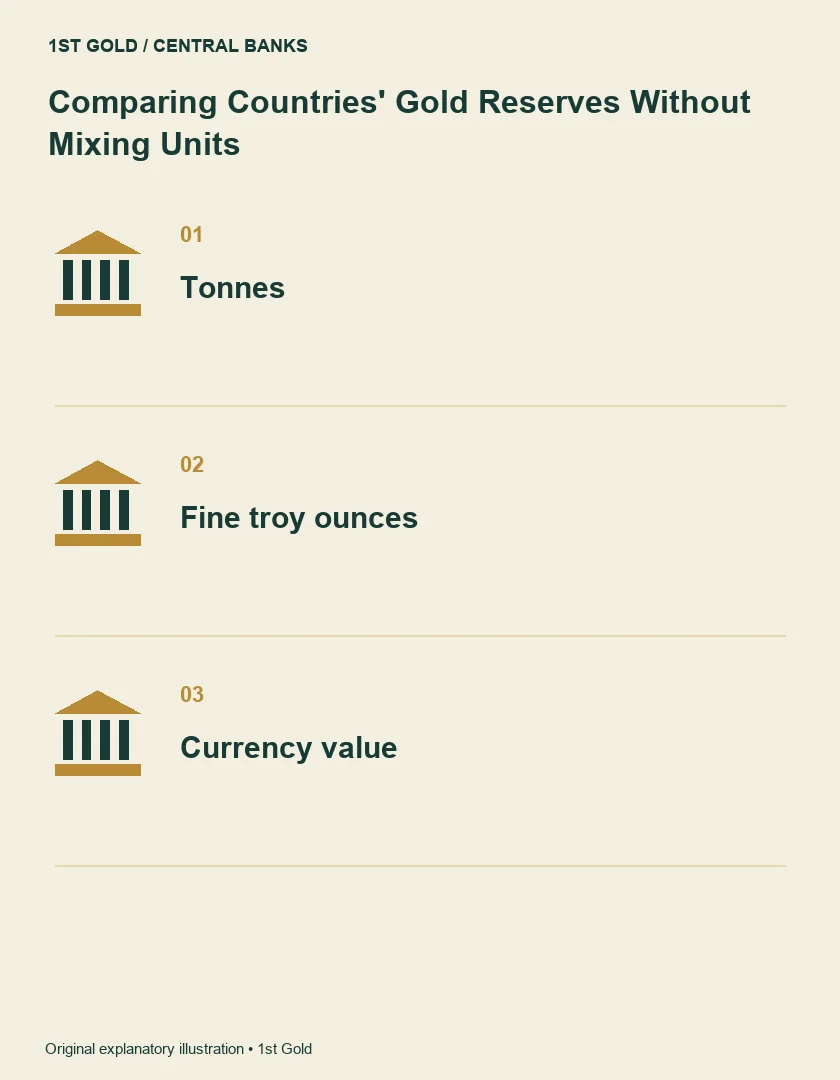
Reserve tables may express gold in tonnes, fine troy ounces, currency value or a share of total reserves. A comparison is meaningful only after the measure and date are aligned.
Choose the question first
If you want to compare physical quantities, use a consistent mass unit. If you want to examine portfolio composition, a percentage share may be relevant. If you compare currency values, the valuation date and exchange-rate basis matter. None of these rankings automatically answers the others.
Preserve the source fields
Keep the original figure and unit alongside any conversion. Record the observation date for each country and note late reporters. Do not silently fill missing values with zero. A country absent from a table is not necessarily a country with no gold. Clear labels and a reproducible conversion method do more for accuracy than a colourful ranking. They also make it possible to update the analysis without losing the meaning of the earlier observations.
Source and further reading
World Gold Council: Official gold reserves and methodology. Reference checked on 14 November 2026. The linked source supports the relevant definitions or background; illustrative calculations above are our own.