
Leveraged gold products require attention to the period over which their objective applies. A stated daily multiple does not automatically describe the product's return over a week, month or a sequence of changing market prices.
A leveraged product may target a multiple of a daily return. That is not the same promise as delivering that multiple over any longer period. Compounding makes the sequence of daily moves important.
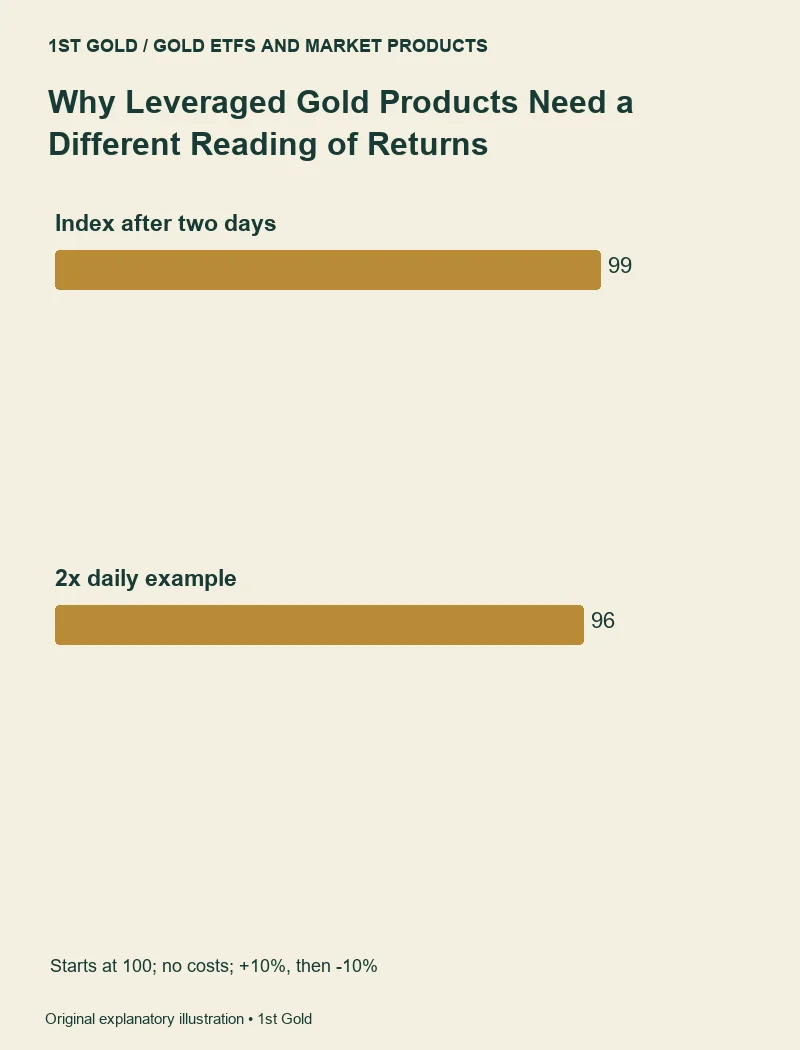
A constructed two-day example
Suppose an index rises 10% and then falls 10%. It moves from 100 to 99. A hypothetical product delivering exactly twice each daily move, before costs, would move from 100 to 120 and then to 96. Its two-day loss is 4%, not twice the index's 1% loss.
Read the objective precisely
Actual products also have costs, implementation limits and risks described in their documents. Inverse products require similar care. Do not use a daily target as a shortcut for a long-term forecast or assume these products behave like ordinary physical-gold holdings. The example explains arithmetic, not an expected investment outcome. Understanding the reset period is essential before interpreting any advertised leverage multiple.
An example for leveraged gold products
In a simplified hypothetical example, a benchmark rises from 100 to 110 and then falls back to 100. The second move is a decline of about 9.09%. A product delivering exactly twice each daily move, before costs, would rise from 100 to 120 and then fall to about 98.18. The benchmark returns to its start, while the daily-reset illustration does not.
This arithmetic shows why the path and reset period matter. It is not a forecast or a complete model of a real product, which has its own costs and operating terms. Read the objective, reset mechanism and risk disclosures together. When assessing a published return comparison, confirm that the benchmark period and the claimed multiple match what the product actually promises to target.