
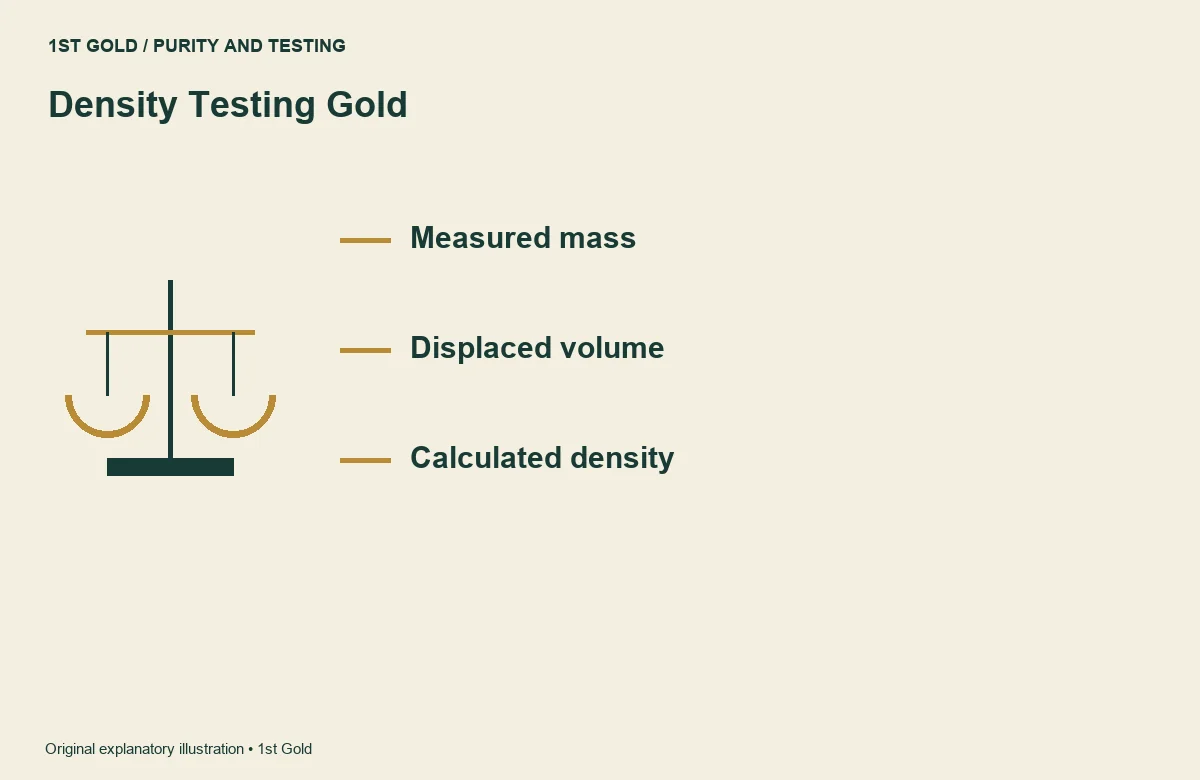
Density is mass divided by volume. Comparing a measured density with an expected value can help investigate a simple object, but the calculation depends on reliable measurements and assumptions about its construction.
Where errors enter
Air bubbles, cavities, attached stones and uncertainty in displaced volume can distort the result. Small objects are particularly sensitive to measurement error. Alloys also differ from pure gold, so the correct reference depends on the product's claimed composition.
Do not overstate the conclusion
An apparently plausible density does not exclude every counterfeit construction. Materials or combinations can be selected to imitate a target density, while an unusual shape can make a sound item difficult to measure. Treat density as one piece of evidence alongside identity, dimensions and other suitable tests. If a valuable item is involved, professional examination is preferable to improvised experiments that could damage it. The most useful report records the method and uncertainty rather than presenting a single number as an absolute verdict.
Source and further reading
LBMA: Physical Market Guidelines. Reference checked on 14 November 2026. The linked source supports the relevant definitions or background; illustrative calculations above are our own.