
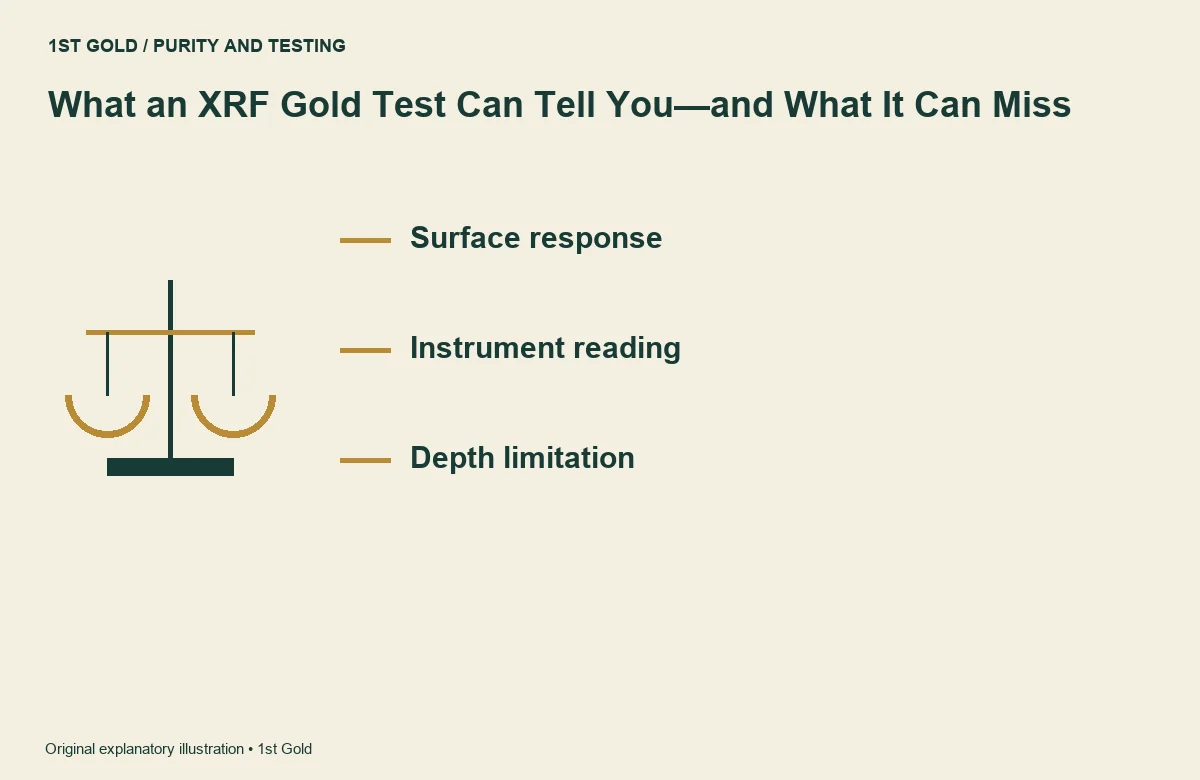
X-ray fluorescence analysis can help identify elemental composition near an object's surface. It is useful in professional precious-metal testing, but a surface reading does not automatically describe the entire interior of a layered or filled object.
Ask about the sample
The result depends on the instrument, calibration, geometry and material examined. A reading from one spot may not represent a complex piece with solder, plating or different components. A professional report should identify the object and explain the method's relevant limitations.
Combine evidence where necessary
For some products, an examiner may use several locations or complementary techniques. The goal is to answer the specific question—such as alloy composition or possible internal substitution—rather than obtain a reassuring number. Avoid treating the displayed decimal places as proof of unlimited accuracy. Keep the test documentation with the item's identity and purchase record. A method can be valuable while still having boundaries; knowing those boundaries makes its result more useful, not less.
Source and further reading
LBMA: X-Ray Fluorescence Testing. Reference checked on 14 November 2026. The linked source supports the relevant definitions or background; illustrative calculations above are our own.